.svg)
Opening a UK Bank Account: How Banking Onboarding Works for Newcomers
An updated system-level overview of UK bank account onboarding for newcomers, explaining identity verification, address records, proof of address, eVisa context, basic bank accounts, financial visibility, credit history and common application friction.
Clear, information-only updates on how key UK systems work — from healthcare and identity checks to everyday administrative steps.
No opinions. No advice. Just structured information to help you navigate your first stages in the UK with clarity and confidence.

Opening a UK Bank Account
How Banking Onboarding Works for Newcomers
Opening a UK bank account is often one of the most important early steps for newcomers.
At first, it may appear to be a simple account application.
In practice, banking onboarding connects several administrative layers: identity, address, immigration-status context where relevant, financial crime checks, source-of-funds context, credit reference data, digital verification and internal bank risk rules.
This article provides a calm, information-only explanation of how UK bank account onboarding works in 2026.
It does not provide financial, legal, immigration, tax or regulated advice.
1. Why UK Bank Account Onboarding Can Feel Strict
UK banks and regulated financial institutions must understand who they are dealing with.
This is part of wider financial crime, anti-money laundering and customer due diligence obligations.
At a system level, a bank may need to understand:
• who the applicant is
• where the applicant lives
• whether identity details are consistent
• whether the account purpose is clear
• whether the applicant’s activity makes sense for the product
• whether additional checks are needed
• whether the application fits the bank’s risk policy
For newcomers, this can feel strict because the UK system may not yet have much local data about them.
A person may have valid documents and lawful status, but still have limited UK address history, limited credit file data or limited financial visibility.
2. Identity Checks
Most banks need to verify a person’s identity before opening an account.
Identity checks may involve:
• passport
• driving licence
• national identity card, where accepted
• biometric or digital identity information where relevant
• selfie or liveness check
• document scan
• data matching against trusted sources
• in-branch verification in some cases
Online banks and high street banks may use different verification journeys.
Some applicants may complete the process entirely through an app.
Others may be asked for additional documents, manual review or an in-branch appointment.
This variation does not always mean there is a problem.
It often reflects how the bank’s identity and risk systems assess the application.
3. Address Records and Proof of Address
A UK address is often important in banking onboarding.
Banks may use address information to support:
• identity verification
• customer due diligence
• correspondence
• fraud prevention
• credit reference checks
• account risk assessment
• regulatory record-keeping
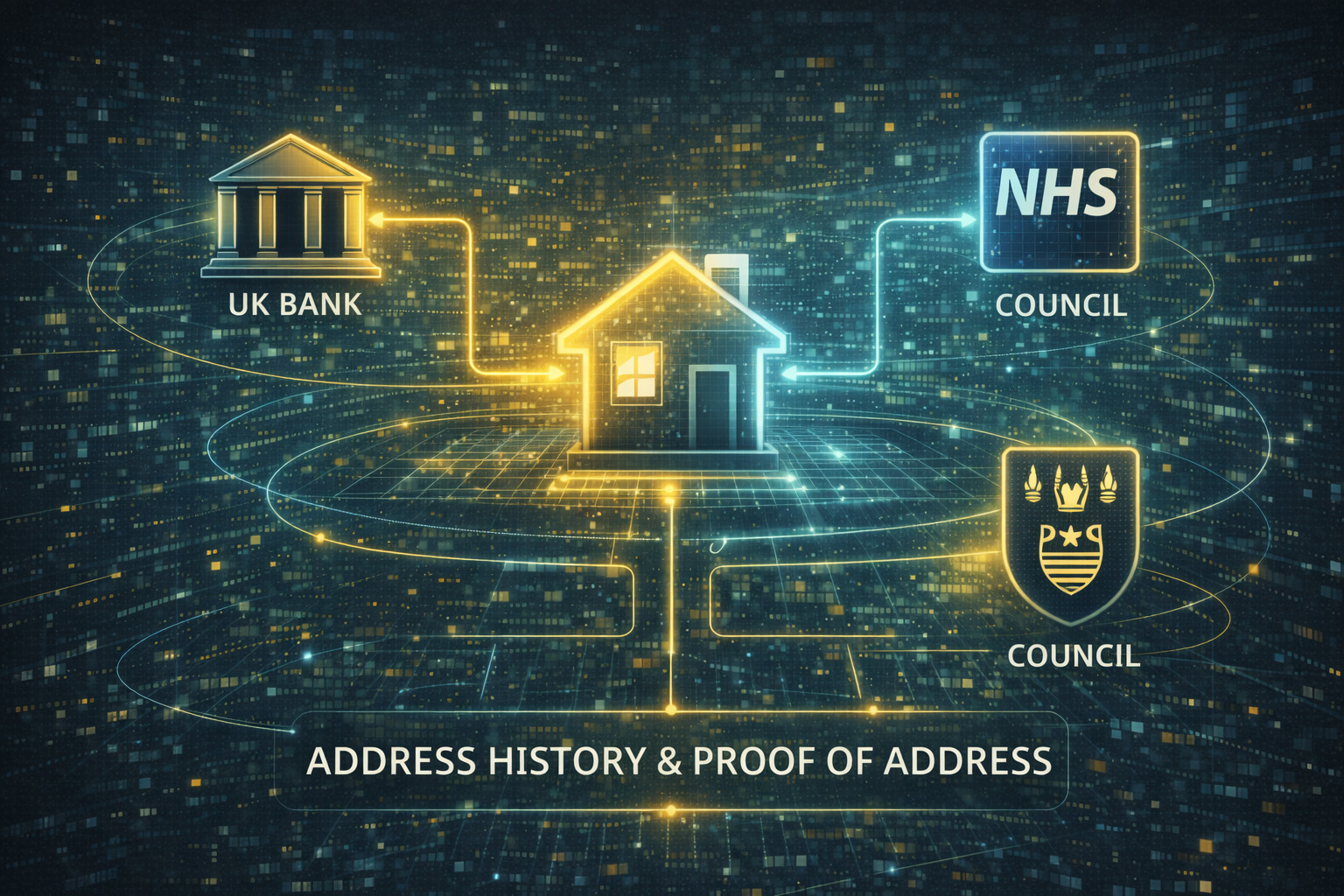
Address history and proof of address are not the same.
Address history is the timeline of where a person has lived.
Proof of address is evidence connecting a person to a specific address at a specific point in time.
For newcomers, this can be difficult because they may have:
• a temporary address
• a new tenancy address
• limited UK bills
• no council tax record yet
• no UK credit file history
• different address formats across documents
• accommodation arranged before arrival
This does not automatically mean the person cannot open an account.
It means the bank may need another way to understand and verify the address context.
4. eVisa, UKVI Account and Banking Context
In 2026, immigration status is increasingly digital.
A person with an eVisa may use a UKVI account to view and prove immigration status where relevant.
An eVisa may show identity and immigration-status information such as name, date of birth, nationality and permissions in the UK.
However, a bank account application is not the same as a Right to Work or Right to Rent check.
A bank may consider immigration-status or residency context where relevant to its onboarding rules, but it will also apply its own customer due diligence, identity and risk checks.
The important distinction is:
• eVisa relates to digital immigration status
• UKVI account provides access to that digital status
• share codes may be used in specific official checking contexts
• bank onboarding is a separate financial-services process
• the bank makes its own account-opening decision under its policies and obligations
This is why a valid eVisa does not automatically guarantee that a bank account will open instantly.
5. BRP and the Digital Status Transition
Biometric residence permits, or BRPs, are no longer the central current-status route in the UK.
The immigration-status layer is now increasingly based on eVisa and UKVI account access.
Some people may still hold an expired BRP as a historic document or transitional access reference, but it should not be understood as the main current proof of immigration status.
For banking onboarding, the practical issue is often not the old BRP itself.
The issue is whether the applicant’s current identity, status context and supporting information can be understood through the bank’s accepted verification route.
This is why digital status, passport details and account access need to be consistent.
6. Credit History and Bank Account Applications
Credit history can affect some banking products, but it does not affect all products in the same way.
A standard current account, overdraft, credit card and loan may involve different levels of assessment.
For newcomers, the issue is often limited UK credit history rather than negative credit history.
Limited UK credit history means the system has less local data to assess.
This may affect:
• identity matching
• automated onboarding
• eligibility for overdrafts
• credit products
• some mobile or utility checks
• risk scoring
• internal bank review
A basic current account may be different from a credit product.
The key point is that lack of UK history can create verification friction, but it is not the same as having bad credit.
7. Basic Bank Accounts
Basic bank accounts exist for people who may not qualify for a standard current account.
They usually provide core banking functions such as:
• receiving income
• making payments
• using a debit card
• setting up direct debits
• managing everyday money
They may not include overdrafts or credit facilities.
For newcomers, a basic bank account can be relevant where the person needs a functional account but has limited UK credit history or does not meet criteria for a standard current account.
However, banks still need to complete identity, address and customer due diligence checks.
A basic account is not a way to bypass verification.
It is a different account type within the banking system.
8. Source of Funds and Account Purpose
Banks may ask questions about why an account is being opened and how it will be used.
This may include:
• employment income
• study-related support
• savings
• family support
• business activity
• benefits or pension income
• expected account activity
• international transfers
• cash deposits
These questions are part of financial crime and risk controls.
They do not always mean that the bank suspects wrongdoing.
They may simply be part of standard onboarding.
For newcomers, it helps to understand that banks are not only verifying identity.
They are also trying to understand whether the expected account activity is consistent and explainable.
9. Online Banks, High Street Banks and Different Routes
Different banks may use different onboarding routes.
Some banks are app-first and rely heavily on:
• digital identity checks
• document scanning
• selfie or liveness checks
• automated risk review
• mobile phone access
• digital communications
High street banks may offer:
• online applications
• in-branch verification
• document review
• appointments
• additional manual checks
A person may pass verification with one provider but face additional checks with another.
This does not automatically mean that one bank is right and another is wrong.
It means that different institutions use different systems, risk policies and accepted evidence.
10. Common Reasons for Delay or Rejection
Bank account applications can be delayed or rejected for many reasons.
Common system-level reasons include:
• identity document not accepted
• poor document scan quality
• selfie or liveness check failure
• name format differences
• changed passport details
• address not matching available records
• limited UK address history
• limited UK credit file data
• unclear source-of-funds context
• inconsistent application information
• unsupported immigration-status evidence
• fraud-prevention review
• internal risk policy
• duplicate or incomplete applications
These situations are not identical.
A technical scan issue, an address mismatch, limited UK data and an internal risk decision are different events.
Understanding the difference helps reduce confusion.
11. Why Name and Address Consistency Matters
Banking systems depend heavily on consistent personal data.
Important data points may include:
• full legal name
• date of birth
• nationality
• passport or identity document details
• current address
• previous address history
• phone number
• email address
• immigration-status context where relevant
• employment or income context
Small differences can create friction.
Examples include:
• initials instead of full names
• missing middle names
• surname and forename order differences
• different spellings across documents
• old passport details
• old address held by another system
• temporary accommodation listed differently
• email or phone number not accessible during verification
For newcomers, this is one reason why UK onboarding systems can feel connected.
A mismatch in one layer may affect another layer.
12. Banking and GOV.UK One Login
GOV.UK One Login is part of the UK government’s digital sign-in and identity environment.
It is not a bank account.
It does not automatically open a bank account.
It does not replace a bank’s own verification process.
However, the broader direction of UK digital services means that identity, address and record-matching are becoming more important across many systems.
A newcomer may encounter GOV.UK One Login, eVisa, HMRC, NIN, Right to Work, Right to Rent and bank onboarding during the same early period.
These systems may use similar identity details, but they are separate systems with separate rules.
This distinction matters.
13. Banking and the First 30 Days
For newcomers, bank account onboarding often sits within a wider first-month structure.
It may connect with:
• digital identity
• eVisa and UKVI account context
• UK address records
• tenancy or accommodation records
• employment onboarding
• payroll setup
• National Insurance number
• HMRC records
• mobile phone access
• credit reference data
• official correspondence
This is why opening a bank account can feel like more than a single application.
It is often one of the first moments when several UK systems try to recognise the same person through consistent records.
14. Common Points of Confusion
Newcomers often confuse:
• proof of identity and proof of address
• address history and proof of address
• eVisa and bank account approval
• Right to Work and banking eligibility
• credit history and identity verification
• basic bank accounts and credit products
• app-based verification and full account approval
• rejection for missing data and rejection for risk reasons
• bank onboarding and government verification
The central point is simple:
Opening a UK bank account is not only about having one document.
It is about whether the bank can verify identity, understand address context, meet its obligations and decide that the account fits its internal criteria.
Final Thoughts
Opening a UK bank account is one of the key onboarding layers for newcomers.
It connects identity, address records, financial visibility, employment, income, digital status context and customer due diligence.
The process can feel strict because banks are not only providing a payment account.
They are also applying regulated financial crime, identity and risk checks.
Understanding banking onboarding as a system helps reduce confusion when applications require extra documents, manual review or alternative routes.
Auralen Note
Auralen provides structured, information-only clarity about UK administrative systems and onboarding layers.
Auralen does not act on behalf of clients and does not provide financial, legal, immigration, tax or regulated advice.